
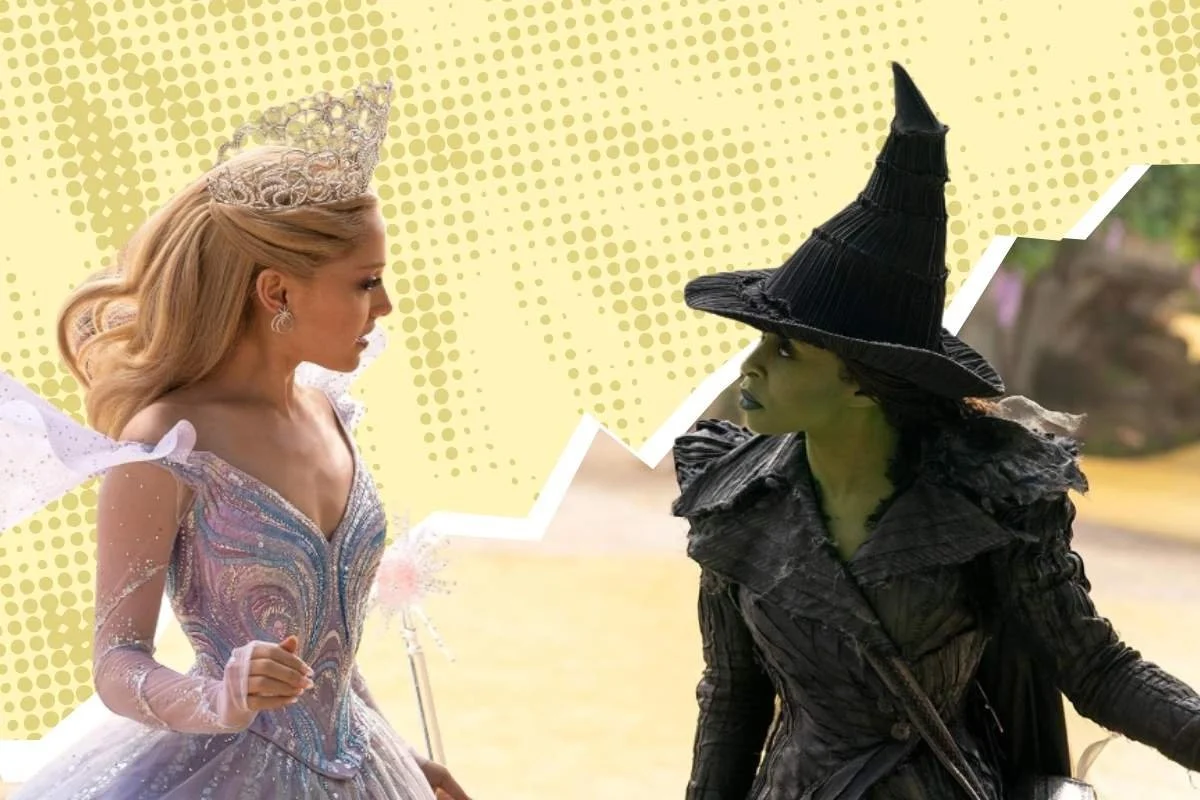
In a deliberate nod to the darker tones of Wicked: For Good (2025), Ariana Grande-Butera transformed her hair colour back to its signature brunette shade, revealed in an Instagram post and its caption that cleverly quotes her character from the film. In press interviews, Jonathan Bailey led with the promise of something more brutal and dark from his character Fiyero. While Cynthia Erivo’s descent into wickedness as Elphaba packed punch.
So, why did the marketing stay, so relentlessly, pink and green?
Brand recognition in film marketing
Wicked: For Good gave us marketing and promotional material at every angle. Pink and green (they go well together, if you haven’t heard), visible across every out of home (OOH) campaign, brand collaboration, and digital channels. This choice, undoubtedly, was to remain faithful to the branding and themes of the films predecessor, Wicked (2024), and its success that grossed the film $758,053,377 worldwide.
But by fiercely matching its branding, the latest release was making an unspoken promise. It positioned itself as a film that offered familiarity, warmth, spectacle, and feel-good theatre magic. What audiences got was something far more complex.
Do mixed reviews mean misled audiences?
In a divisive but attention-drawing move, The New Yorker published “Wicked: for Good” is very, very bad. on the November 20 2025, a day before the blockbusters general release. It details the authors disappointment in Wicked: for Good as an empty narrative, far away from the original source material, and frames it as a shell of its counterparts within the Oz universe. There’s a lot to unpack here. But, coming from a thought leading publisher, this review had impact.
Meanwhile, Wicked: for Good debuted with 70% on Rotten Tomatoes and a score of 62 on Metacritic, signalling changing audience feelings, compared to its predecessor Wicked’s debut Rotten Tomatoes rating of 92%. Then, came more waves of initial reviews, from more Rotten Tomatoes echoeing the latest film’s darker tones, to critics being disappointedly less spellbound.
If you’ve watched the film (and don’t worry, no spoilers ahead!), you’ll know that the narrative and plot takes a darker turn. We don’t agree that the film lacks magic. And while Wicked and the surrounding Oz franchise has a legion of loyal and in-the-know fans who expected this tonal shift, there’s no denying that the public, and most movie-goers, weren’t expecting a change.
Good movie marketing and audience hand-holding
This raises the question, should effective movie marketing and film promotion hand-hold audiences and prepare their expectations? Or should a film’s nuance be a delightful surprise, even if it raises eyebrows?
The marketing and promotion of Wicked: For Good sold us bubblegum, then gave us something sharper, darker, but in our opinion, with heaps of heart.
What the Wicked: For Good marketing got right
A charming cast, multi-channel content creation, and candid interview moments where the memes build themselves. Flurries of brand partnerships that meant the signature pink and green could be found everywhere. Leaning into brand activation in a way that only big-budget blockbusters can truly do.
Immersive experiences, pop-ups, and displays of props from the film that bring audiences closer than ever. The list could go on. The marketing for Wicked: For Good truly represents a behind the scenes marketing team confidently striving for all-or-nothing, with zero need for hesitation.
Charming, meme-worthy cast interviews
Cynthia Erivo can’t stop accidentally becoming a meme during the Wicked: For Good press circuit. So much so, she had to delightfully explain herself as new memes appear. And we love it.
If there’s anything to learn from the Wicked: For Good marketing efforts, it’s that your cast shouldn’t just be great actors. If they’re charming and charasmatic, they’ll help the film go far, long after your directors yell “that’s a wrap!”.
In Wicked: For Good, the whole main cast shines. But no friendship has received quite-so-much attention as Cynthia Erivo and Ariana Grande-Butera. From candid interview moments like “holding space”, which became a leading meme of 2024 on social. To Cynthia protecting Ariana from a wayward fan ambush on the red carpet, a display of genuineness that sparked even deeper respect for the cast and generated conversation.
If your cast has great personalities, it will only strengthen your film marketing if you capture them.
Behind the scenes
We predict that film marketing in 2026 and beyond will lean into audiences desire to take a peak behind the scenes. It’s no secret that the movie world is an exclusive and glamorous circle. Who hasn’t watched a film and wondered how they built that set, casted that actress, achieved that camera shot, and gawked in amazement at the sheer number of people listed in the film credits.
The Wicked: For Good marketing tapped into this curiosity. A quick browse of Instagram reveals not only @wickedmovie with exclusive behind the scene footage front and centre, but also @wickedthesoundtrack with equally attention-grabbing cast moments. Que less visible cast members members chiming in with their excitement about the film. We particularly loved Bethany Weave’s behind the scenes Instagram post of at her character, Dorothy Gale, including Oscar the dog who played Toto.
And yes, the marketers gave us a look closer, too. @makeituniversal celebrates the people behind Universal Studios. And Michael Anderson, Digital Marketing Manager, Universal Studios shared his story from behind the scenes. As film marketing nerds, we’re obsessulated with this sneak peak.
Good film marketing social isn’t just film clips. It’s full-circle insight into the film production and distribution process.
A brand activation and yellow Brick Lane, London, UK
Organic, the PR specialist agency within Havas Play UK, transformed London’s iconic East End Brick Lane into the ‘Yellow Brick Lane’ to create an attention-grabbing brand activation in partnership with Universal Pictures.
The collaboration with local artists saw the area transformed with painted yellow bricks, artwork inspired by the latest film release, and a neon sign; “because I knew you, I have been changed for good”. It turns a popular tourist location into a photo opportunity for eager Wicked fans, and sparks new curiousity for unknowing passers-by, making it a powerful and memorable method of brand activation.
How the Wicked: For Good marketing strategy caused confusion
Spectacle, not story
If you’ve said to yourself, “huh, Wicked’s everywhere”, you’re not wrong. While we can sing the praises of brand partnerships and their power in film marketing, is the pink and green overload a little too much for this film?
Glinda isn’t pink in this film, she’s blue
What if there had been a softer, darker approach? In Wicked: For Good we see the character of Glinda in a distinctly blue-hued dress, crucially during emotionally-charged moments of the film. Perhaps swapping the marketing’s iconic green and pink with green and blue (and still pink-ish) tones could’ve been a subtle nod to the darker narrative. This change in colour could’ve sparked conversations. Curious press interviews divulging the film’s tonal shift, making it more visible to the public. Darker posters and imagery to match, indicating to audiences that they’re in for something slightly different to the film’s predecessor.
Brand recognition trumps storyline
So why not? Maybe in this case, brand recognition trumped storyline. And this is especially important for popular films with broad audiences and reach.
Audiences don’t always go into the movie theatre informed. Many audiences simply watched Wicked (2024) last year, enjoyed it, and are returning for a similar experience again.
If a specific colour resonate with the familiarity of the franchise’s brand, then it’s commercially-minded and clever to continue playing with it. Especially for a release as big as Wicked: For Good. However, we’d argue with such a well-known cast, ironed-out franchise, and strong brand recognition in other areas, a small change in the marketing’s tonal direction couldn’t have hurt.
And maybe the groups of audiences who felt the film didn’t meet their expectations would’ve had different ones in the first place. Maybe they would’ve felt less misled.
What audiences had to say about Wicked: For Good
In the spirit of investigative journalism, we asked audiences why they think Wicked: For Good received mixed reviews.
"I think the reason a lot of the reviews are mixed are because people know the songs from the second-half less.”
“The movie narrative followed the original Wizard of Oz film. If you don’t know about a certain house crushing incident, you might wonder what’s going on.”
“I didn’t understand why Dorothy’s slippers weren’t red.”
And if you’re curious, the answers here.
“It wasn’t as light as the first movie, but I don’t think that was a bad thing.”
Well there you have it. There’s no doubt that the impact of these takes on Wicked: For Good and its success is nearly non-existent. Its global total at the end of opening weekend stood at $226m. Oh my Oz.
It’s always interesting to watch what film producers and distributors with big budgets choose to do with their marketing. And we suppose and hope that Universal Pictures, its marketing team, and all its partners couldn’t be happier with their results.
Discover more from the film circuit


So why did the marketing stay, so relentlessly, pink and green?