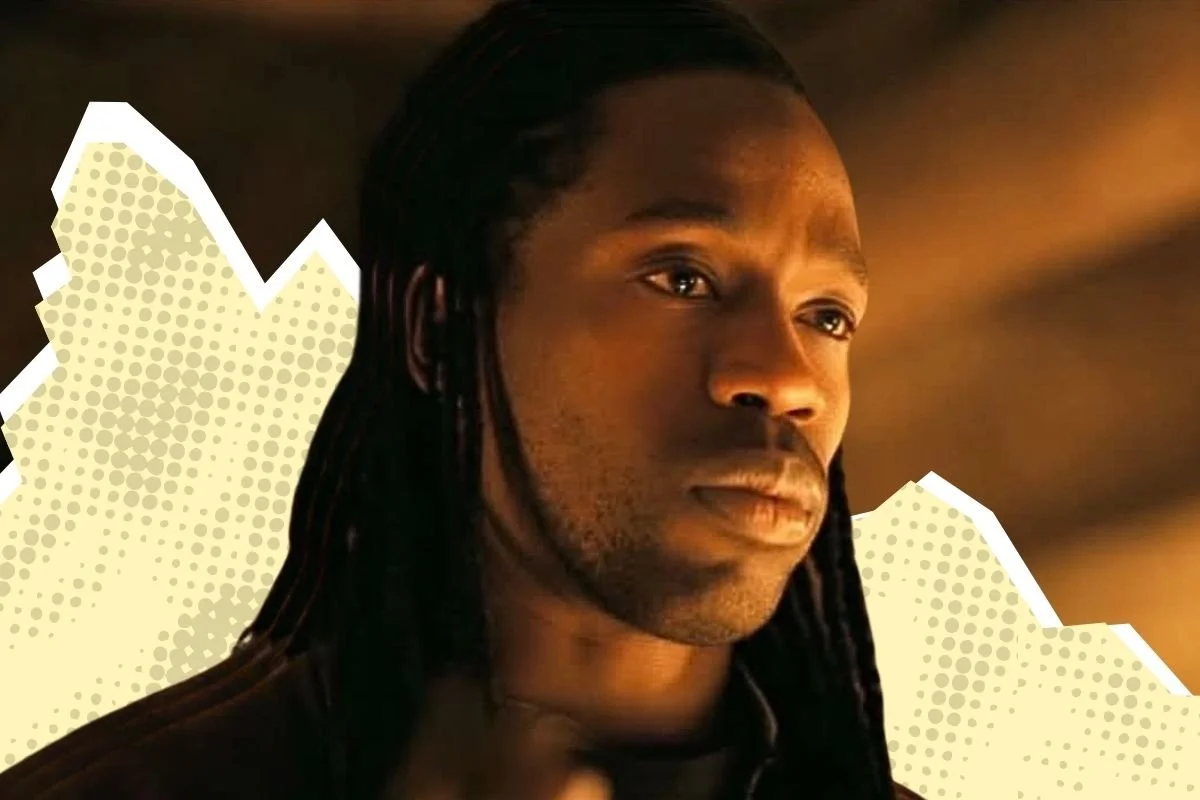
In January, a trailer for Christopher Nolan's The Odyssey aired during an NFL playoff game and, twenty seconds in, showed Travis Scott, Grammy-nominated, arena-filling, not previously known for Homeric verse, addressing a room of soldiers about the fall of Troy. Within the hour, the internet had done what it does: clipped it, captioned it, called it unexpected. By July, when the film opened and Scott's role as the bard Demodocus was fully revealed, the extent of his role wasn’t scene stealing, just scene setting.
The two had crossed paths before. Scott wrote and performed "The Plan" for the closing credits of Nolan's 2020 film Tenet, a collaboration Nolan later called the final piece of a yearlong puzzle. This time, Nolan wanted him in front of the camera, not just behind the soundtrack. Explaining the Odyssey casting, Nolan has said plainly that he wanted to nod toward the idea that this story survived as oral poetry, something he considers analogous to rap, through the role of a bard.
“I cast him because I wanted to nod towards the idea that this story has been handed down as oral poetry, which is analogous to rap…”
Christopher Nolan, The Odyssey, Director, speaking to Time Magazine
A bard, in the historical sense, is a poet, storyteller, and musician rolled into one. Shakespeare gets called a bard for exactly this reason. In Celtic and other ancient cultures, bards held a specific and respected role: they memorized and sang the history of their people, carrying stories of wars and kings and journeys forward through generations, before any of it was written down.
The Odyssey itself comes out of that tradition. It's an ancient Greek epic, attributed to Homer, that follows the hero Odysseus on a ten-year journey home to Ithaca after the Trojan War, and for centuries before it was ever a text, it existed the way bards preserved everything: recited aloud, passed voice to voice. Penguin’s essential guide to The Odyssey is helpful here.
Scott's character, Demodocus, is a bard within that story, one of the first figures the audience sees. He opens the film reciting the fall of Troy to a room of soldiers, setting the events of the plot into motion the way a real bard might have once set a listener's evening.
Freestyle in the booth
Composer Ludwig Göransson, who scored the entire film and had previously won an Oscar for Nolan's Oppenheimer, booked studio time right after Scott's first watch of the finished film, and the two went straight from the screening into a session, with Demodocus's own lines from the script running as placeholders in the mix. Scott began working around them, eventually bringing in James Blake to trade verses with him, Blake voicing something like a Siren's call while Scott raps as a traveler still trying to find his way home. Nolan himself ended up credited as a co-writer on the track.
The result, "When I'm Home," closes out the film's twenty-three track soundtrack and leans into the same themes Demodocus recites on screen: distance, longing, the pull of home. It's less a promotional single than an extension of the character, Odysseus's journey translated into Scott's own register. He later went a step further and directed the song's music video himself.
The Odyssey crossed $1.553 billion worldwide in its seventh weekend, including $563.8 million in North America and $988.8 million overseas. One thing’s for sure, this is a creative project Scott is surely proud to be part of.